

If You Reuse It, Prove It Was Sterile

Single-use cartridges and disposable tubes have simplified a lot of tattoo setups. But if your shop reprocesses any reusable instrument that must be sterile, the machine itself is not proof. Sterilization is a controlled process: cleaning, packaging, loading, cycle parameters, indicators, storage, testing, and records. Skip one link and “we ran it through the autoclave” becomes guesswork.
Follow the rule that applies to your shop
Body-art sterilization requirements are usually local, and the equipment manufacturer’s instructions matter. Illinois defines sterilization as destroying all living organisms, including spores, and its Body Art Code sets operational standards. Confirm whether your local rules permit the reusable item, require an onsite sterilizer, specify testing frequency, or require a service relationship.

Barrier protection is part of the legal and safety baseline. Photo: Sergej Karpow / Unsplash
Cleaning comes before sterilizing
Organic material can interfere with the process. Handle contaminated instruments with appropriate protection, clean them using the approved method and equipment, inspect them, and package them before the cycle. Keep clean and dirty movement physically clear. An autoclave is not a washing machine and a sealed pouch is not evidence by itself.
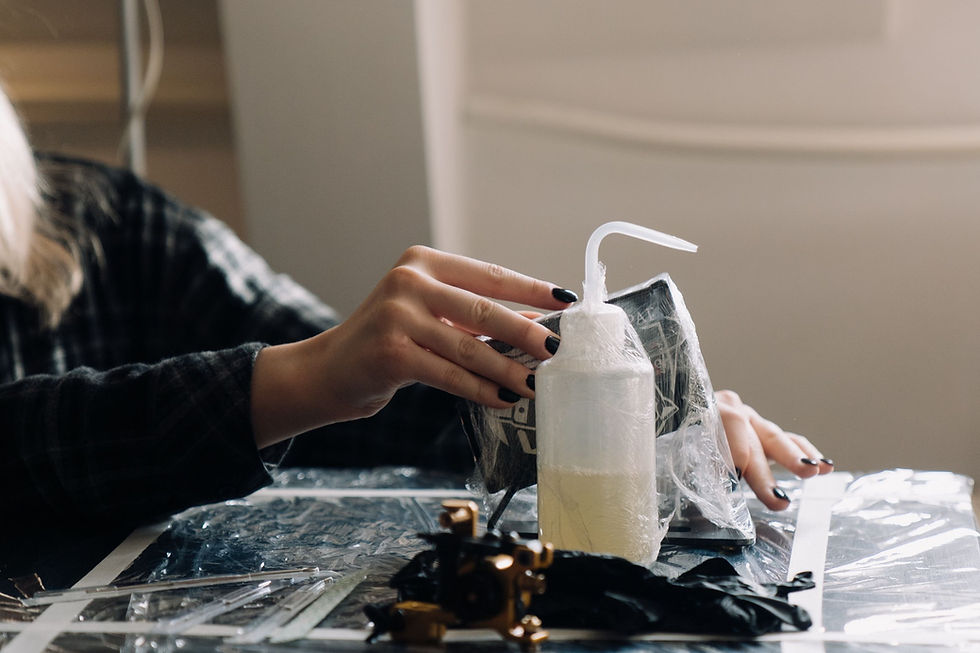
Disinfecting a barrier-wrapped tattoo workstation. Photo: cottonbro studio / Pexels
Indicators do different jobs
Chemical indicators help show exposure to process conditions. Biological indicators—spore tests—challenge whether the sterilization process can kill highly resistant organisms. OSHA enforcement guidance discusses checking autoclave efficiency with indicators and reviewing documentation such as run details, calibration, and routine spore-test results.

Tattoo equipment arranged with sterile packaging in a working studio. Photo: Pavel Danilyuk / Pexels
Records make the process real
Log date, operator, load, cycle parameters, indicator result, maintenance, calibration, and biological-test result as required. Create a response plan for failed tests: stop using affected equipment, quarantine loads, investigate, correct, retest, and notify whoever must know. Keep records where staff and inspectors can retrieve them.
The shop-floor check
Confirm local rules and manufacturer instructions.
Separate dirty cleaning from clean packaging.
Use required chemical and biological indicators.
Log every cycle and test result.
Write the failed-test response before it happens.
Pick one weak point, assign it to a real person, and put a date on the correction. A policy nobody owns is only decoration.
Know when disposable is the better system
Reusable equipment can be lawful and safe when the shop has the facility, training, validated process, maintenance, and records to support it. If those pieces are missing, switching an item to a compliant single-use option may remove a fragile step instead of creating more paperwork theater.
Do not throw away the sterilization history when equipment changes. Keep records for the required period, document the transition, and make sure staff know which items are single-use. A mixed system is where assumptions grow: one person thinks it was discarded, another thinks it was sterilized.
Keep one page you can actually find
Put the key proof for this issue in one clearly named shop record. The point is not building a legal library. It is making the current answer, responsible person, and supporting documents retrievable before a booking, inspection, dispute, or emergency forces everyone to search from memory.
Instrument and cleaning method.
Package and load record.
Cycle parameters and operator.
Indicator and spore-test results.
Maintenance and failed-test response.
Review that page at renewal, before travel, or whenever the process or provider changes. Mark old material as superseded instead of quietly mixing it with the current rule. Clear version control is boring right up until it saves the appointment.
Sources and further reading
Illinois Body Art Code: https://www.ilga.gov/agencies/JCAR/EntirePart?titlepart=07700797
OSHA autoclave documentation guidance: https://www.osha.gov/enforcement/directives/cpl-2-244d
OSHA Bloodborne Pathogens standard: https://www.osha.gov/laws-regs/regulations/standardnumber/1910/1910.1030
This article provides general U.S. educational information, not legal or medical advice. Requirements vary by jurisdiction and can change; confirm the current rule with the responsible agency or a qualified local professional.



Comments